Audio Kino Reel to Reel Tape Recorders

Company Description

Audio Kino was created the way much of post-war Hungarian industry was: by state consolidation. In the summer of 1950 the existing RAFILM works were merged with several small private companies — among them the firms of Nagy Andor, Vörös Rezső and Pulvári Károly — all nationalised together into a single state enterprise, the Audio Hang- és Kinotechnikai Vállalat, the ‘Audio Sound and Cinema-Technology Enterprise,’ in Budapest.

Where RAFILM had made amplifiers, turntables, radio-studio equipment, sound columns and projectors — essentially everything needed for public-address and cinema sound — the new Audio enterprise broadened that further, adding magnetic tape recording to the catalogue. It was a wide-ranging audio works rather than a specialist recorder maker, and tape was one promising new branch among many.

Two lawsuits, two new names: Audio → EAG → BEAG★ 
The company’s name had a turbulent life of its own. In 1956 the American Audio Co. sued the Hungarian firm for misappropriating its name, and as a result ‘Audio’ became EAG — Elektro Akusztikai Gyár, the Electro-Acoustic Factory. That name didn’t last either: in the summer of 1960, at a Budapest exhibition, the long-established West German firm AEG objected to the strikingly similar EAG and compelled yet another change. EAG thus became BEAG, the Budapesti Elektro Akusztikai Gyár.

Under the BEAG name the enterprise grew into one of Hungary’s principal audio manufacturers, a maker of amplifiers, speakers and professional sound equipment that endured until it was wound up, without a successor, in 1992. Even then the story didn’t quite end — that same year its leading designers and engineers founded a new company, BEAG Kft, to carry the work forward. The little adapter of 1954 had been the seed of a national audio institution.

Hungary’s first consumer magnetic recorder — the AK 154 / AM 155 adapter
Audio’s place in history rests on a genuine first. In January 1954 the company presented a magnetofon adapter — the earliest magnetic sound recorder built for general public use in Hungary, carrying the model designations AK 154 and AM 155. (The Magyar Rádió had cobbled together a handful of players from leftover foreign parts in 1951, but those were one-offs; Audio’s was the first meant for ordinary buyers.)

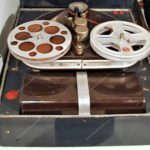
It was an ingenious, economical design rather than a self-contained machine. The adapter sat on top of an ordinary record player and took its drive from the turntable’s centre spindle; the electronics that handled the tape heads lived in a separate box, which plugged into the pick-up input on the back of a radio set, with a rotary switch to choose between record and playback. A modest thing on paper — a single tape speed of 19.53 cm/s, a 60–6000 Hz response, a handful of tubes (2×6AU6, 6AG5, 6X4) in a 2.5 kg case — but at a time when a full tape machine was out of reach for most households, running tape off the family record player and radio was the cheapest way in.

Source of Info

Audio Kino Reel to Reel Tape Recorder ModelsSubmit New Model

General Information

Manufacturer: Audio Kino

Years in Business: 1950 To 1959

Country: Hungary

Years making R-R Tape Recorders: 1954 To 1959