
In order to use this feature, you need register and become a member.
Already a member? Login Register hereEricsson Reel to Reel Tape Recorders
1876 To Present
Company Description Submit New Info
When the Phone Company Made Tape Recorders
L.M. Ericsson is one of the most documented companies on earth — a telecommunications giant founded in 1876, the maker of telephone exchanges, radio links and, eventually, the inventor of Bluetooth. Somewhere in that vast history sits a footnote most of its own engineers have probably never heard of: for a brief time, in the mid-1950s, Ericsson built domestic tape recorders.
A sideline called the Ericorder
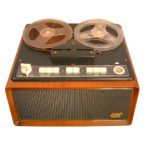
The machines were sold under the name “Ericorder,” and they came from a dedicated little tape-recorder works — the Bandspelarfabriken — in Örebro, Sweden. They were modest, consumer-aimed tube/valve machines: two-track, mains-powered, built for the home rather than the studio. In an era when the company’s main pages were filled with 960-circuit coaxial systems and automatic telephone exchanges, the Ericorder was a curiosity even within Ericsson.
Two models, well made
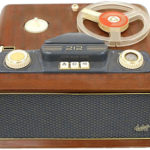
The first was the BAB-2, built around 1954–55: a valve recorder using an ECC81/EF86/EL41 line-up, with the characteristic green “magic eye” tuning indicator of the period. It was followed in 1957 by the KTB-212, a neat teak-chassis portable that travelled in its own carrying bag and is preserved today, complete with schematics, in collector archives. Both were the work of a company that knew precision engineering intimately, even if recorders were never to be its business.
Documented in its own house journal
The most charming proof of the venture survives in Ericsson’s own pages. The company’s in-house magazine, the Ericsson Review, devoted an article in its 1957 volume to “A New Tape Recorder — Ericorder KTB 212,” slotted in among reports on telephone exchanges and railway signalling. It is a rare thing: a global corporation pausing, mid-stride, to introduce a little machine for recording at home — before returning, as it soon did, to the business of connecting the world by wire. The Ericorder was a short chapter, but a genuine one, and the surviving machines remain a quietly surprising reminder of how wide a great company’s curiosity could once roam.