

In order to use this feature, you need register and become a member.
Already a member? Login Register hereSchaub-Lorenz Reel to Reel Tape Recorders

1880 To 1990s
Company Description Submit New Info
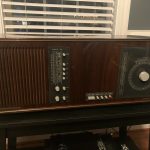
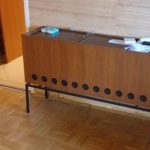
Perhaps the most unique or unusual tape recorder ever invented, the Schaub-Lorenz Music Center could record 46 hours music on a wide tape. Five years of development and a big price tag translated to an unusual story of failure.
Schaub-Lorenz Tape Recorder Production
in 1961, Graetz KG was purchased by Standard Elektrik Lorenz AG (SEL) and they consolidated some teams that would do the engineering for a new consumer electronics division branded as Schaub-Lorenz.
From a historical perspective, it’s useful to know that in 1959, Graetz had bought another consumer electronics company, Saja. The teams that had previously worked in the tape recorder division were relocated to the Graetz factory in Westphalia. After the move, it turned out strangely, that Saja had not provided adequate technical or production drawings for the previous tape recorder efforts so they were back to the drawing board. The former boss at Saja’s plant in Duderstadt was the only guy that really knew everything about the older tape recorders, but was no longer available. A strange transition. So for almost 2 years they attempted to get back into production, without success. But some new talent was just around the corner as 4 engineers from East Germany had escaped and were in a refugee camp in West Berlin. These were tape recorder guys, that had worked for an East German company, Funkwerk. They were hired and moved to Westphalia and it was around this time in 1960, that development of the Schaub Lorenz Music Centre began. The idea or concept this new tape recorder had arrived with Friedrich Knochenhauer who was planning it’s possibilities in 1959 at ‘Funkwerk Köpenick’ back in East Berlin.
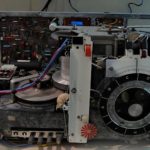
This unique tape recorder had some serious engineering challenges as the tape had to be very large at 10 cm wide and was 150 m in length. Elasticity while preserving strength was the issue and no such tape had ever been produced. PVC was the first experiment and was lacking smooth tape transport. Polyester was the next choice. There seems to be no info to what the final tape solution was. With this length of wide tape, the new machine could record 46 hours of music!
A huge engineering effort with multiple manufacturing processes did finally result in production machines, however they determined that mass production was not a possibility as these machines were too complex. After five years of product development, two models were released in 1965 at the Hannover Messe, the 5001 & 5005 and later a 120v export model for the US, the 6000.
Approximately 1500 Schaub Lorenz Music Centers were produced and priced for the rich and famous. These were sold in Germany, the UK and American markets. Sales were sluggish at the original steep prices and then they were discounted significantly, with many sold in the UK.
5001- The most popular, a stereo table model with 126 tracks
5005- Console model with black metal stand, a turntable and 4-band FM/AM radio with an alphanumeric dial. With similar but not identical electronics to the 5001, the mono 5005 radiogram models were more reliable than the 5001. A 5012 mixer was listed as an accessory.
6000- Stereo tape recorder with 81 tracks for the US export market at 120V.
Apparently these unusual tape recorders were not very reliable but are still serviceable. Refer to the source below for more info.
The Schaub-Lorenz brand continued well into the 70s, manufacturing portable radios and a variety of other product.
Source – Some great research posted on this website
Promotional Material – April 1965 brochure
History
1880 – Carl Lorenz, established as C. Lorenz Aktiengesellschaft or C. Lorenz AG, a telegraph construction company in Berlin, Germany.
1921 – George van Schaub established the company Schaub in Berlin
1923 – C. Lorenz AG starts manufacturing radios
1930s – International Telephone and Telegraph (ITT) acquired C. Lorenz and Standard Electric
1940 – C. Lorenz AG purchased the Schaub Apparatebau GmbH
1950s – Starts manufacturing tape recorders.
1952 – Introduced “Illustra”, the first color television set in Europe.
1961 – Schaub-Lorenz brand introduced
1965 – Schaub Lorenz releases the 5001 Music Center (with 46 hours of playback)and 5005 ‘radiogram’ model.
1967 – Discontinues production of the Music Center. Becomes biggest German manufacturer of portable radios
1990 – General Trading bought the Schaub Lorenz brand.
Schaub-Lorenz Reel to Reel Tape Recorder ModelsSubmit New Model
General Information Submit General Info
Manufacturer: Schaub-Lorenz
Years in Business: 1880 To 1990s
Country: Germany
Years making R-R Tape Recorders: 1950 To 1967
A thorough research article on Schaub Lorenz Music Centres