
In order to use this feature, you need register and become a member.
Already a member? Login Register hereTapesonic Reel to Reel Tape Recorders

1949 To 1972
Company Description Submit New Info
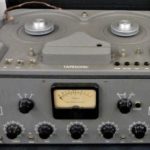
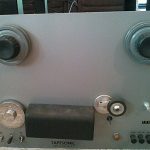
Tapesonic decks were manufactured at Premier Electronic Labs located in New York city at 382 Lafayette St.
The business started in the late 1940s making tube based tape recorders, which are still excellent today and transitioned into solid-state around 1964. The business was a collaboration between Adolph “Sam” Miller, the machinist, who built the chassis and was responsible for the transport functions. Harry Kolbe took care of the electronics and alignment.
Looking at the solid-state machines, it’s hard to know who borrowed from who, with these machines having similarities with Crown and Magnecord and to some degree, Ampex.
Tapesonic is one of a handful of US-made machines that are well worth the restoration investment, sounding better than the best Japanese consumer machines made into the 1980s.
Priced at approximately $600, Tapesonics were custom made to order and sold direct from the factory, bypassing retail markups. A comparable machine, made by Crown, was double the price.
The TR series was their first all-solid state version.
Four models were available:
70-TRSQ (quarter-track stereo),
70-TRSH (half-track stereo)
70-TRH (half-track mono)
70-TRF (full-track mono)
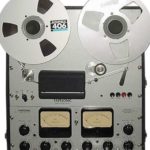
Outwardly, the basic transport system had remained virtually unchanged since the first Model 70 – three motors, three heads, push-button relay and solenoid-operated transport controls and 10½ inch reel capacity.
What had changed was than now, the capstan motor was direct-drive hysteresis synchronous, the reel motors were high-torque unshaded capacitor types, gold-plated contacts on relays, remote control capability, all solid-state componentry with five plug-in modular boards, regulated power supply and two tape tensioning arms. A four-inch heavy-duty dynamically balanced flywheel and non-magnetic stainless steel flutter-filter, tape lifters and tape guides all helped to ensure tape handling was smoother and wow and flutter much lower than earlier models. No pressure pads are used and wow is kept to a minimum (0.08% at 15 ips) by using a ball bearing pinch roller to reduce the load against the capstan. Speed change is entirely electrical with no pulleys or belts involved.