
In order to use this feature, you need register and become a member.
Already a member? Login Register hereFerrograph Reel to Reel Tape Recorders

1949 To 1981
Company Description Submit New Info
Of the many British firms that tried their hand at tape recorders in the post-war decades, most did not last — by one account the average lifespan was about nine and a half years, and plenty folded inside of two. Ferrograph lasted around thirty — and for most of that time it was the machine a professional reached for when the recording simply had to be great.
A conversation that changed a components firm
The company that became Ferrograph began as Wright and Weaire, incorporated in 1920 to take over the instruments business of J. G. Wright and T. G. Weaire, and making radio components from a factory in Tottenham, north London, from 1922. Two of the men who would steer it into tape recording joined young: Richard Merrick started in 1928 as a tester and inspector of components, and Ernest Niblett — later remembered as the “architect” of the company’s post-war success — began in those same early days, rising to joint managing director alongside Merrick.
The turning point was a single introduction. In 1947 Merrick met Louis Fishoff, who had recognised tape recording as a coming growth market and pressed Merrick to look into building a recorder. Merrick took the idea to Niblett, who confessed he had been quietly interested in the technology for some time. They decided, more or less on the spot, to pursue it. The result, in 1948, was the Wearite Tape Deck.
Six engineers in South Shields
A factory was established far from London, in South Shields on the north-east coast, and a team of six technical engineers was engaged. By the middle of 1948 the first Ferrograph recorder had been produced, and in 1949 a separate company, the British Ferrograph Recorder Co Ltd, was set up to market the machines, owned by the same shareholders as Wright and Weaire.
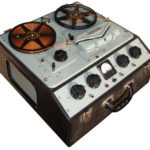
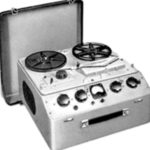
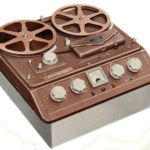
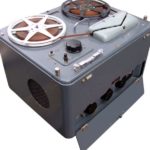
What set the machines apart was their build. Ferrographs were heavy, precise instruments — frequently three-motor designs, with speed accuracy held to around two-tenths of a percent and frequency response reaching 15 kHz at the higher tape speeds. These were never meant as mass-market consumer goods; they were aimed at the semi-professional, the serious hi-fi enthusiast, the broadcaster and the laboratory. At the company’s early-1960s peak, more than a hundred machines a week were being hand-built at South Shields. Decades later, collectors still describe the Series 5 and 6 machines with rueful affection as “big old clunkers, built like tanks.”
The company that owned two words
Ferrograph’s most quietly remarkable achievement never appeared on a spec sheet. Wright and Weaire registered the term “Tape Deck” as a trademark — and for years that forced competitors into awkward circumlocutions like “tape-panel” to describe the transport mechanism. A phrase that is now generic the world over was, for a time, the legal property of a single British firm.
Absorption, and a wider range
Success brought consolidation. In 1958 Wright and Weaire renamed itself the Ferrograph Company, moving manufacturing into a new subsidiary. In 1959 the firm was absorbed by the Wilmot Breeden Group, which broadened the range beyond recorders into amplifiers, radio tuners and monitor loudspeakers. Through the 1960s the Ferrograph range continued more or less unabated.
The Series 7: the machine that broke the spell
Then the world changed around it. By the late 1960s, recorders from the Continent and Japan — Akai, Teac, Sony, Revox — were arriving with up-to-date styling and features the staid British machines lacked. Vertical operation had become the new fashion. Ferrograph answered with the Series 7, first released in late 1968 and sold in many variants well into 1974. On paper it addressed everything: vertical operation, variable bias, variable rewind, all solid-state. It even earned a genuine distinction — the Dolby (D) variant of 1972 made it the first reel-to-reel recorder in the world to incorporate Dolby B noise reduction.
On the bench, it was a different story — and worse, it was the kind of trouble a company built on reliability could least afford. For the first time in Ferrograph’s history, the machines came back. Excessive head wear showed up almost immediately, with customers returning decks after three months; there were faults with the auto-stop switch. The root cause was the most damning detail of all: far from being a clean new mechanical design, the Series 7 had been cobbled together in roughly six months, in a desperate rush to reach the market on time. Ferrograph fixed the faults quickly enough — but not before a reputation carefully built over twenty years had been badly dented. The spell of unbreakable Ferrograph reliability, once broken, did not fully return. (Restored today, with a rebuilt pinch roller and fresh capacitors, a Series 7 is once again the fine-sounding machine it was always meant to be — the engineering was sound; only the haste was not.)
The marriage, and the Receiver
The end, when it came, followed close behind. By 1977 falling sales had produced heavy losses, and to safeguard jobs the National Enterprise Board arranged what one account called a “marriage” between Ferrograph and North East Audio Ltd (NEAL); Wilmot Breeden sold the company for £500,000. NEAL took on almost the whole product range. It was not enough. In 1981 the company passed into the hands of the Receiver, and Ferrograph’s three-decade run as a maker of reel-to-reel recorders came to a close — one of the last of the British studio-grade survivors, finally undone, like Brenell and Leevers-Rich before it, by the arrival of digital recording.
Post-WWII
Wright and Weaire announced their decision to retire and offered the company to Richard Merrick, Ernest Niblett, and Walter Berridge.
1945 – Production transferred from Tottenham to a bigger factory at South Shields
1948 – Weairite Deck prototype later incorporated into the first Ferrograph tape recorder that was delivered in early 1949
1949 – The British Ferrograph Recorder Company founded as a separate company marketing tape recorders, owned by Wright and Weaire
1950s – Series 4 – Model 4A introduced with two tape speeds, 3 3/4 and 7 1/2 ips Model 4AH 7 1/2 and 15 ips.
1957 – Ferrograph introduced patents for demagnetizing devices.
Late 1950’s – Series 6 – half track stereo machine with 8.25 inch reels and using standard 1/4 inch tape.
1959 – Ferrograph was absorbed by the Wilmot Breeden Group and begins making a wider range of products that includes amplifiers, radio tuners and monitor loudspeakers
1960’s – At the height of the company’s sales success, Ferrograph Patents the term “Tape Deck” as a registered trade mark
1967 – Rapid development of the Seven
1976 – Releases Studio 8
1977 – The National Enterprise Board approached North-East Audio Ltd (NEAL) and Wilmot Breeden sold the Ferrograph company for £500k