

Technical Details
Brand: Tandberg
Model:TD-20A
Category:Super High Fidelity
Application:Consumer
Electronics:Solid State
Country of Manufacture:Norway
Release dates:1978 - 1978
Original Price: $2400
Tracks:1/2 Rec/PB
Speeds: 7 1/2, 15
Max Reel Size("): 10.5"
Number of heads: 3
Dimension: 43.5x45x19.5
Head Composition: Permalloy, Ferrite
Head Configuration: Stacked/Inline
# Motors: 4
Voltage(s): 110-120v, 220-240v, Multi
Outputs: RCA, DIN
Sound quality rating:8 / 10
Long-term reliability rating: 8/ 10
Weight: 17 kg.
Additional Details
Description
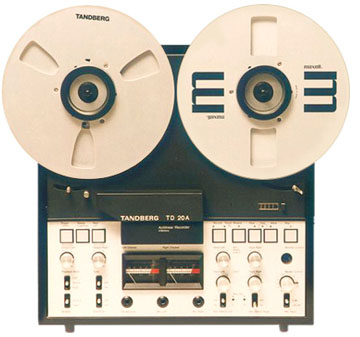
This was the second last recorder Tandberg produced before their demise in December 1978.
The TD 20 A was Tandberg’s first open-reel recorder to incorporate a new Actilinear recording process. This replaced their previous approach of using a crossfield 4th head. ACTILINEAR recording brought a significant 20 dB increase in the ability of the electronics to handle a much stronger signal, resulting in lower distortion and better transient response while improving intermodulation distortion. Tandberg were also many years ahead of their competition having chosen to use higher grade Elna electrolytic capacitors that still perform well to this day. It should be noted however that the power supply capacitors were of a different type, Frako, that didn’t have as long lifespan, so these should be replaced without exception. The musicality of this deck is quite significant relative to any top-end Japanese recorders. When used on a higher end sound system, the 20a offers a much richer, detailed sound.
In recent years, owners of these machines have discovered some relatively small problems that can be overcome to keep them running (read service suggestions below)
The Tandberg 20A was available in four configurations, half track, quarter track, high-speed (15 – 7.5ips) or low speed (71/2 – 3 3/4ips)
Features
- Full-logic functionality with smooth transitions through all the functions.
Four Motors – Capstan brushless synchronous motor with belt drive and a heavy flywheel to isolate vibrations from the motor to the capstan. Direct coupled reel motors controlled by a program read only memory with a trial output to provide constant tape tension.
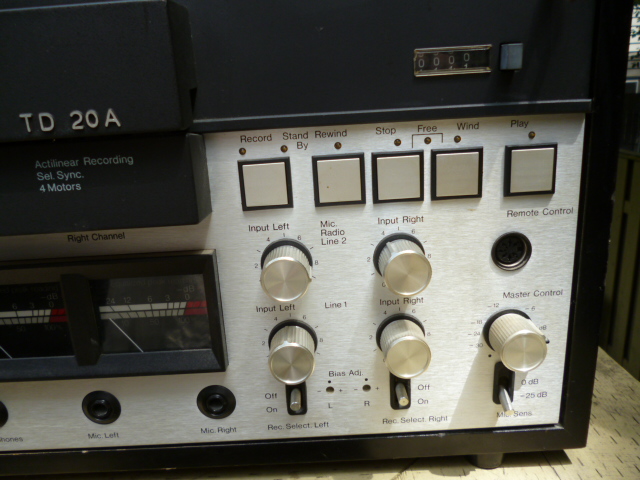
– Four record-level controls with a master record control for mic/line and line/line mixing
– Front-panel bias adjustment controls
– Switchable 25 dB microphone attenuator
– Peak-reading equalized meters
– Optional infra-red remote control
Additional Info
Service Suggestions/Considerations
Top of the list includes removing the pinch roller arm assembly and re-lubricating the pivot and this should be done on all 20A’s including SE
Replace Frako big capacitors in power supply x 4
Belt replacement x 2
Optional- replace the capacitors in the signal path with audio grade capacitors like Elna Silmic II or Nichicon UFG
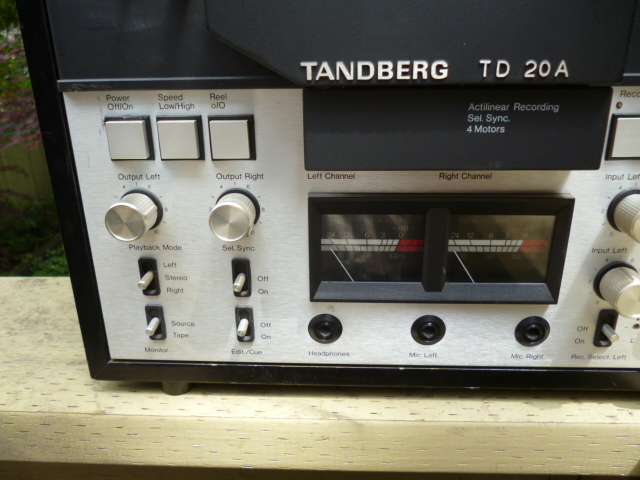
Over time, the 3 switches on the left (Power, Speed, Reel size) may stop engaging. Finding replacements is unlikely. A passible solution for the power is to install an in-line switch on the power cord.
The next most important, speed might not be a big issue, depending on your preference. If you have the low-speed 3.75, 7.5 model (the most common) a simple insertion of something to hold the switch in position might just do the trick, if you don’t use the slower speed very often.
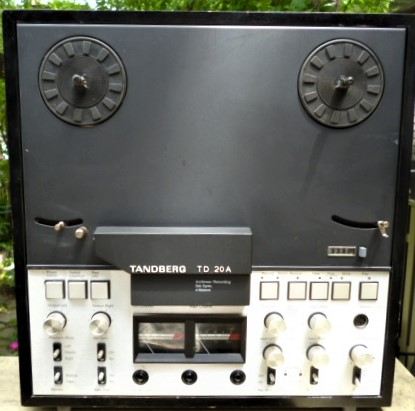
The plastic reel tables was a poor design decision on Tandbergs part.
Some people have been re-creating these with 3D printers using harder plastics.
In spite of these service considerations, the 20A and SE models should not be taken off your list if you are considering a top-of-the-line Japanese machine and you have a great sounding system. These sound better.
Wow and Flutter
38 cm/s: 0,03%
19 cm/s: 0,05%
9,5 cm/s: 0,10%
Frequency Response
38 cm/s: 15-34000 Hz
19 cm/s: 15-30000 Hz
9,5 cm/s: 20-18000 Hz
Signal to noise ratio 69 dB