

In order to use this feature, you need register and become a member.
Already a member? Login Register herePioneer Reel to Reel Tape Recorders

1936 To 2021
Company Description Submit New Info
Pioneer
Founded as the Gospel Electric Works by a missionary’s son who heard a Western speaker and resolved to build one in Japan — a family firm that grew into a hi-fi giant, won the receiver wars, invented the car CD player and consumer GPS navigation, carried LaserDisc alone for a decade, built the best plasma TV ever made and nearly died of it, and today rules the world’s DJ booths under another name.
Pioneer began with a single act of listening. In 1932, Nozomu Matsumoto — born in Kobe in 1905, the son of a Christian missionary — heard a Western-built Philco dynamic speaker and was so struck by its tone that he resolved to build such a thing in Japan. Nearly everything the company did for ninety years — the receivers, the LaserDisc, the plasma screens, the DJ decks — traces back to that resolution: sound, reproduced so well it moves people.
The missionary’s son and the Gospel Electric Works
Working from a small Osaka workshop, Matsumoto succeeded in 1937 with the A-8 dynamic speaker, among Japan’s first — and christened the speaker itself “Pioneer,” a name that would wait a quarter-century for the company to grow into it. The firm he formalized in Tokyo in January 1938 carried his faith in its name: Fukuin Shokai Denki Seisakusho — the Gospel Electric Works — born of his belief that his products could serve his missionary inheritance. It was a family enterprise in the most literal sense. The Matsumotos lived above the factory. His wife Chiyo served as company cook, maintenance staff, and accountant. His sons Seiya and Kanya worked the production line as boys while their father was out making deliveries. The trademark registered in 1947 fused the Greek omega — the symbol of electrical resistance — with a tuning fork: engineering and music in one mark.
Surviving the war, then the name catches up
The war nearly ended the story before it began. The firm survived as a subcontractor to Tokyo Shibaura Denki (Toshiba), building transformers for aviation radios; the speaker materials sat out the bombing in a relocated factory in Saitama, and production resumed from them when peace came. Incorporated as Fukuin Denki in 1947, the company spent the 1950s as a respected component maker — the PE-8 hi-fi speaker (1953) its calling card — profitably selling drivers to the very rivals it would later challenge. The decisive turn came in 1961: the company took its product’s name, becoming Pioneer Electronic Corporation, and in 1962 introduced the PSC-5A stereo set, the first stereo with detachable speakers — a break from the one-piece console that became the industry’s standard format.
The sons, and the outsider
The founder’s two halves split cleanly between his sons. Seiya Matsumoto, a Chuo University business graduate and a natural salesman, ran sales from the postwar years until he became president in 1982; Kanya Matsumoto, mechanical like his father, had to be coaxed into the firm at all, and ran engineering and manufacturing. And in a move that says much about Nozomu Matsumoto, in 1963 — having positioned his family firm against Japan’s giants — he admitted the family alone couldn’t manage what came next and recruited Yozo Ishizuka from Toshiba as managing director. Under this triumvirate Pioneer rode Japan’s component-stereo boom — a market Seiya’s marketing did much to create. The company’s shares went on sale to the public on the Tokyo exchange in 1961, and by 1976 Pioneer stock was also traded on the New York Stock Exchange — a Japanese family hi-fi firm, now owned in part by American investors — and for a time Pioneer was the best-known hi-fi name in the world.
The reel-to-reel chapter: late in, distinctive out
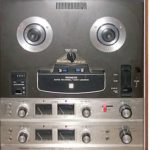
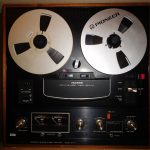
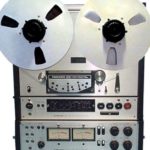
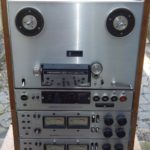
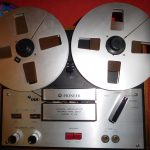
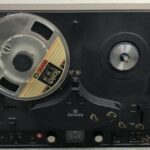
Pioneer came to open reel late — around 1969, well after Akai, Sony, and Teac — and its early T-series reel decks (T-6600, T-8800) and mid-1970s RT-1011/1020/1050 reel decks were competent mainstream machines in a crowded Japanese field. Its lasting contribution arrived in 1976–79, when Pioneer stopped imitating the category and restyled it: the rack-mount RT-701/707 reel decks and the 10.5-inch RT-901/909 reel decks, low, wide, and built to slot into the Spec-series racks — the reel deck reimagined as a system component rather than a wooden-cheeked appliance.
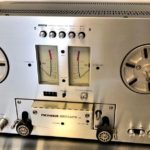
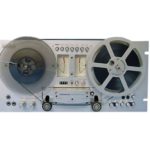
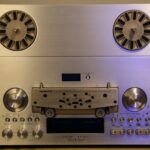
The RT-707 reel deck — direct-drive, four-head, auto-reversing, famously durable — found a second life in radio stations, which bought the 701/707 as a compact, economical alternative to professional decks. The RT-909 reel deck (1979), with its fluorescent metering and big reels, became the poster machine of the line and remains one of the most sought-after quarter-track decks on the vintage market. The design language was influential enough that Akai’s GX-77 visibly followed it. The RT-2022/2044 half-track decks (1976) marked Pioneer’s ceiling: semi-professional machines, the most serious it ever built.
The exit was on Pioneer’s own terms. The company had bet on optical media early, and the RT-909 was quietly kept in production for export until about 1984, advertised from the back pages of catalogs while the front pages sold LaserDisc. Open reel remains the moment Pioneer’s industrial-design confidence met magnetic tape — a short chapter that produced two of the category’s most loved objects.
The receiver wars, and the house of Locanthi
Pioneer’s 1970s were loud in every sense. The receiver wars against Marantz, Kenwood and Technics escalated wattage year on year until Pioneer ended the argument with the SX-1980 receiver (1978) — 270 watts per channel, about 35 kg, the most powerful mass-market receiver of the analog era and still a collector trophy. To fight JBL in speakers, Pioneer hired the enemy’s chief weapon: Bart Locanthi, the engineer behind JBL’s greatest drivers, whose HPM-100 loudspeaker (1975) was aimed squarely at his own former JBL L100. Locanthi’s deeper legacy was TAD — Technical Audio Devices (1975), Pioneer’s professional driver division, whose beryllium compression drivers ended up in recording studios and cinema systems worldwide.
Statement lines · Exclusive (1974) · Spec (late 1970s) · TAD (1975– )
Pioneer ran three named premium initiatives, and their fates diverge exactly as the pattern predicts. Exclusive — Japan-only, cost-no-object amplifiers, turntables and horn speakers — endured into the 2000s as the domestic prestige line. Spec was the exportable version: rack-mount separates as a styling-and-system flagship, which is why the RT-707/909 reel decks are shaped the way they are. TAD outlived everything: revived as a consumer high-end marque with Andrew Jones’s Reference One loudspeaker (2007), it survives today as an independent company — Pioneer’s Esoteric, where Sony’s Esprit faded.
The enthusiast’s Pioneer: the rest of the rack
Turntables. Pioneer served both ends of the market and excelled at both. The PL-12D turntable (early 1970s) was the budget belt-drive that introduced an entire generation — especially in Britain — to component hi-fi: cheap, decent, and everywhere. At the summit, the Exclusive P3 turntable (late 1970s) is spoken of by Japanese-vintage collectors as one of the finest direct-drive turntables ever built, a massive coreless-motor statement piece that today trades for many times its launch price; the stable also included serious mid-tier direct drives like the PL-570 and the quartz-locked PL-L series with linear-tracking arms.
Cassette decks. Pioneer’s cassette catalog peaked with the late-1970s CT-F1000 and CT-F1250 cassette decks — three-head, rack-styled flagships that sat naturally beside the RT-707 in a Spec rack and competed head-on with Nakamichi’s mid-range and the best of Sony and Teac. The serious tier was exactly where the doctrine predicts: single-well, three-head, fixed-head machines; Pioneer’s later auto-reverse convenience decks belong to the lower end.
Amplifiers & tuners. Beyond the receiver wars, enthusiasts remember the M-22 class-A power amplifier (mid-1970s) — a 30-watt pure class-A design with an outsized reputation for sweetness — the matching SA-9500/SA-9900 integrated amplifiers, the TX-9500-series tuners, and above them all the Exclusive C3 preamplifier / M4 power amplifier pairing, the Japan-only summit gear that gave the brand its domestic prestige.
Headphones. A quieter thread, with one genuine oddity: the SE-700 headphone (1970s) used a “high-polymer” piezoelectric film driver — a technology almost nobody else shipped — alongside the conventional SE-L series and the SE-Monitor 10. Decades later the thread re-emerged where Pioneer had moved: the HDJ series DJ headphones became booth standards next to the CDJs.
Speakers carried the Locanthi story told above — the HPM line at retail, TAD in the studios — and the CS-series paid the bills for decades. The point for a reader is the breadth: at its late-1970s peak, a committed enthusiast could assemble an entire serious system — source, tape, amplification, speakers, headphones — from Pioneer’s catalog alone, and many did exactly that in a single Spec rack.
Beyond audio: the LaserDisc obsession
Pioneer’s defining bet was optical. Through a joint venture with America’s MCA it brought the LaserDisc to market in 1979 — the first consumer optical-disc format, three years before the CD — and when its partners lost their nerve, Pioneer bought them out (DiscoVision Associates, with IBM’s stake, 1982) and carried the format essentially alone for two decades. LaserDisc never beat VHS in the West, but Pioneer found its killer application at home: laser karaoke, which became a fixture of Japanese and Asian social life and quietly funded the format. The commitment bordered on devotion — Pioneer shipped its final LaserDisc players in 2009, thirty years after launch. The optical thread ran on through DVD development, a 16-layer 400 GB Blu-ray demonstration (2008), and the disc drives that kept the name alive in computing.
The car: Pioneer’s second empire
The business that actually sustained the company was built where the hi-fi press wasn’t looking. From a 1966 US distribution relationship with Craig-Panorama, Pioneer built the world’s dominant car-audio operation — Supertuner radios, the component car stereo, and two genuine world firsts: the CDX-1 car CD player (1984, two years after the home CD launched) and the AVIC-1 GPS car navigation system (1990) under the carrozzeria brand — consumer satellite navigation before most drivers knew the satellites existed. When everything else was sold or shuttered, car electronics is the business today’s Pioneer Corporation kept.
Kuro: the masterpiece that nearly killed the company
Pioneer entered flat panels early — the world’s first 50-inch consumer plasma display (1997) — and by 2007 had produced Kuro, the plasma line whose black levels reviewers treated as the reference against which every television was measured, and often still is. It was also ruinously expensive to make against collapsing LCD prices. The losses forced the 2006 resignations of president Kaneo Ito and chairman Kanya Matsumoto — the founder’s son, ending seven decades of family presence at the top — and in 2009–10 Pioneer exited televisions entirely, cut thousands of jobs, and survived on stakes taken by Honda, Sharp and Mitsubishi interests. Kuro engineers famously dispersed to Panasonic and elsewhere; enthusiasts still speak of the cancelled tenth-generation panels the way audio people speak of unbuilt flagships.
The last act: the DJ booth and the private-equity exit
Pioneer’s final consumer triumph came from reading a room others ignored: the DJ booth. The CDJ series — culminating in the CDJ-1000 digital deck (2001) — did for club DJs what Technics’ SL-1200 turntable had done a generation earlier, becoming the de facto standard in booths worldwide. It was profitable enough to sell: the DJ division went to KKR in 2015 and thrives today as AlphaTheta, still trading under the Pioneer DJ brand. Home audio-visual went to Onkyo the same year (and onward, after Onkyo’s 2022 bankruptcy, to the Voxx/Sharp joint venture). In 2019 Baring Private Equity Asia took the shrunken parent private, ending 58 years on the Tokyo exchange. Pioneer Corporation persists as a car-electronics firm; the name Nozomu Matsumoto gave a loudspeaker in 1937 now lives on separately in car dashboards, home receivers, and DJ booths — three companies, one tuning-fork legacy.
1936– Munoz Matsumoto (1905–1988) founded the Fukuin Shokai Denki Seisakusho company in Japan. The son of missionary, Matsumoto’s company name means “Blessed Sound Electric Company”.
1937– Matsumoto builds the A-8 dynamic speaker, based on a Philco model he heard earlier, and named it the “pioneer”
1938– Matsumoto started the Fukuin Shokai Denki Seisakusho Company (FSDSC), making speakers in his garage, then started a small factory that repaired radios and speakers
1953– FSDSC released the PE-8 Hi-Fi Speaker.
1961– The FSDSC name is changed to Pioneer Electronic Corporation
1962– Pioneer made the world’s first separate channel stereo system with detachable speakers
1964– Pioneer released S-71X modular stereo set, making Pioneer a recognizable name with its success
1966– Pioneer marketed its automotive stereo players through Craig-Panorama
1975– Pioneer made its first component car stereo
1976– Pioneer releases the RT 707 & RT 2044
1979– Consumer Laser Disc introduced. Pioneer released the RT-909, and made them until 1984
1982– Pioneer made its first CD player, marking the end of its R-R recorder efforts
Pioneer Reel to Reel Tape Recorder ModelsSubmit New Model
General Information Submit General Info
Manufacturer: Pioneer
Years in Business: 1936 To 2021
Country: Japan
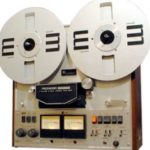
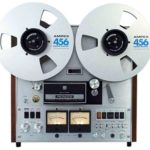
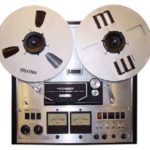
Pioneer reel to reel tape recorders were produced in very decent quantities in the 1960s and 1970s making them one of the top five most significant Japanese tape recorder manufacturers of the time.
The top 4 most interesting Pioneer reel to reel tape recorders for higher end audio
RT-707 – A very unique tape recorder that many have described as bombproof and it has a unique dimension or size, designed for 7 inch reels and featuring autoreverse.
RT-909 Rack mountable, very excellent specifications and unique display. Expect to pay very good money on the secondhand market for an RT-909
RT-2022 and RT-2044 Two Semi professional models which were the highest end reel to reel tape recorders that Pioneer produced.
Here is a Pioneer Service Overview from a fully qualified technician here in Canada that offers his opinions on Pioneer reel to reel tape recorders.